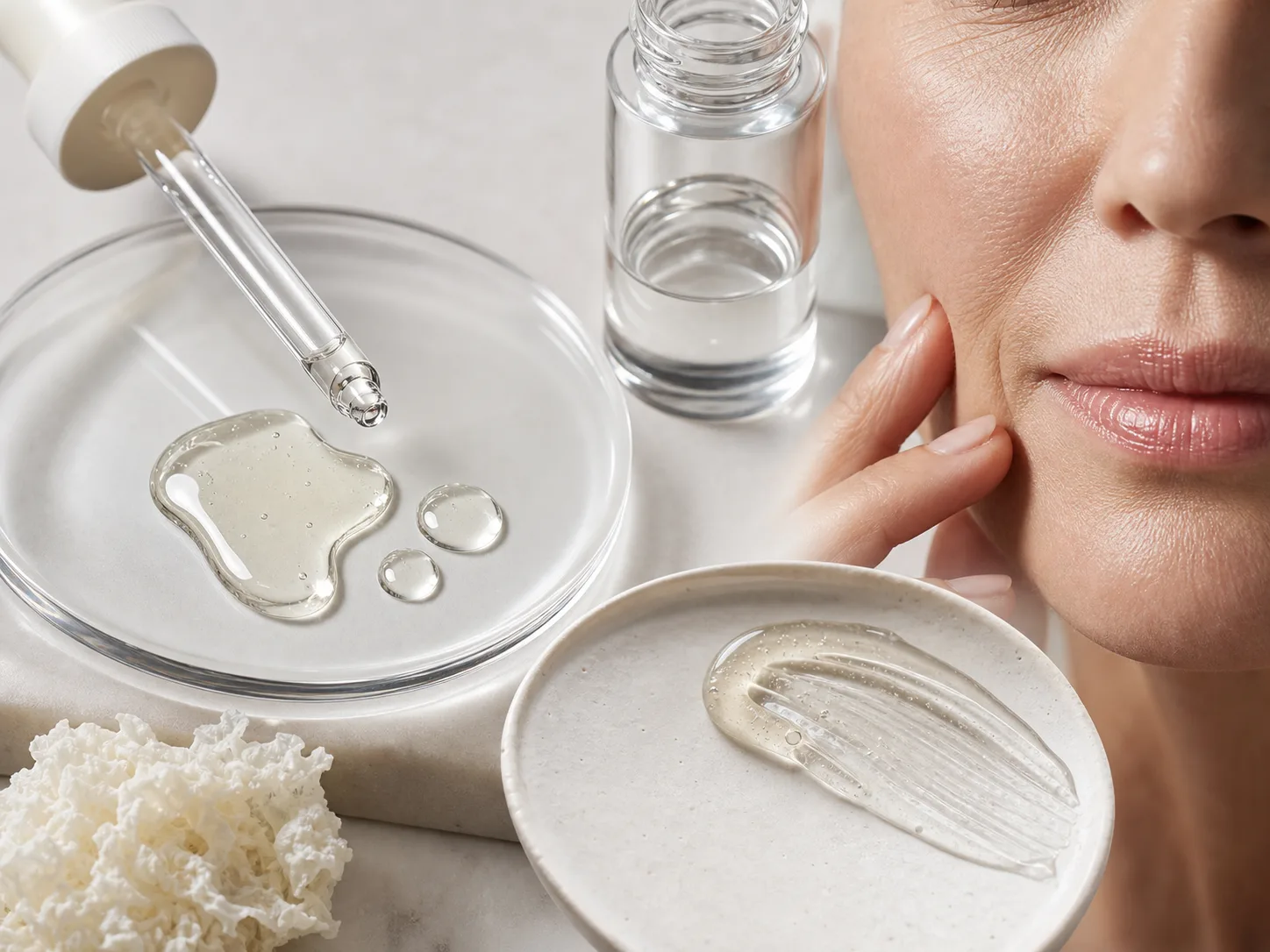
sh-Oligopeptide-1 targets repair signaling and smoother texture
sh-Oligopeptide-1 products are designed around skin repair signaling, smoother texture, and a firmer appearance. Biologically active EGF can bind EGFR and influence keratinocyte proliferation, migration, survival, adhesion, and differentiation. The same pathway operates only when its peptide remains active and reaches the relevant skin environment; immediate plumping still comes mostly from the moisturizing base.
Biologically active epidermal growth factor is a signaling protein. It binds the extracellular part of the epidermal growth factor receptor, or EGFR, on a cell membrane. Binding changes the receptor shape, allows two EGFR molecules to pair, and activates the intracellular tyrosine-kinase domains.
The paired receptors phosphorylate tyrosine sites that recruit signaling proteins. Downstream routes include RAS-RAF-MEK-ERK, which influences proliferation and migration, and PI3K-AKT, which supports survival and metabolism. In skin biology, EGFR signaling helps regulate keratinocyte proliferation, adhesion, migration, survival, and differentiation.
EGF must remain active and reach skin cells
If a topically applied molecule remained stable, crossed the stratum corneum, retained the correct three-dimensional structure, and bound EGFR at an effective concentration, the biological expectation would be altered keratinocyte signaling. That could influence surface renewal and recovery.
Those are demanding conditions. EGF is a protein, and proteins are vulnerable to heat, oxidation, proteases, and formulation conditions. Their size and water solubility also make passive passage through an intact lipid-rich stratum corneum difficult. The ingredient name on a jar does not tell us whether active EGF reached receptors in living skin.
sh-Oligopeptide-1 is not automatically active EGF
Cosmetic products often connect sh-Oligopeptide-1 with the name EGF. A 2023 critical review examined that assumption and concluded that preclinical bioactivity proving sh-oligopeptide-1 to be a functional EGF had not been established. It also questioned clinical papers that treated the cosmetic INCI as bioequivalent to active recombinant human EGF.
What finished-cream studies can and cannot show
A multi-ingredient cream containing sh-oligopeptide-1 may improve hydration, texture, or firmness ratings. Humectants, emollients, occlusives, antioxidants, and the test design all contribute. Unless the study compares an otherwise identical formula with and without the peptide, it cannot isolate the peptide effect.
Hydration alone can make fine lines look softer because swollen corneocytes reflect light more evenly and the surface becomes smoother. That is a useful cosmetic result, but it is not proof of EGFR activation.
How to judge an EGF-marketed product
Look for a disclosed active identity, concentration, stabilization method, packaging, and a finished-product controlled trial. Airless or protected packaging may help a fragile protein, but packaging cannot prove receptor bioactivity.
For routine use, judge the moisturizer first: overnight tightness, surface smoothness, pilling, fragrance, and tolerance. If the company provides receptor-binding or cell-signaling data for the exact ingredient and a controlled finished-product study, the growth-factor claim becomes more credible.
Sources used
- COSMILE Europe: SH-Oligopeptide-1INCI identity and skin-conditioning function of SH-Oligopeptide-1
- Critical review of topical sh-oligopeptide-1Critical assessment of whether SH-Oligopeptide-1 can be treated as bioactive EGF
- Topical growth factor preparations for facial rejuvenation: systematic reviewEffect sizes and heterogeneity across 33 topical growth-factor studies
- EGFR activation and skin biologyHow active EGF binds EGFR and initiates receptor signaling
- EGFR regulation of epidermal barrier functionRole of EGFR signaling in keratinocyte differentiation and epidermal barrier biology
- Formula-specific sh-oligopeptide-1 cream studyFinished-formula evidence where the peptide effect cannot be isolated from the full cream
- egf-association.jpMaterial composition and formulation use
- cosmetics.specialchem.comIngredient characteristics and cosmetic use
- marieclaire.comIngredient characteristics and cosmetic use
- womanandhome.comIngredient characteristics and cosmetic use