How titanium dioxide protects skin from UV
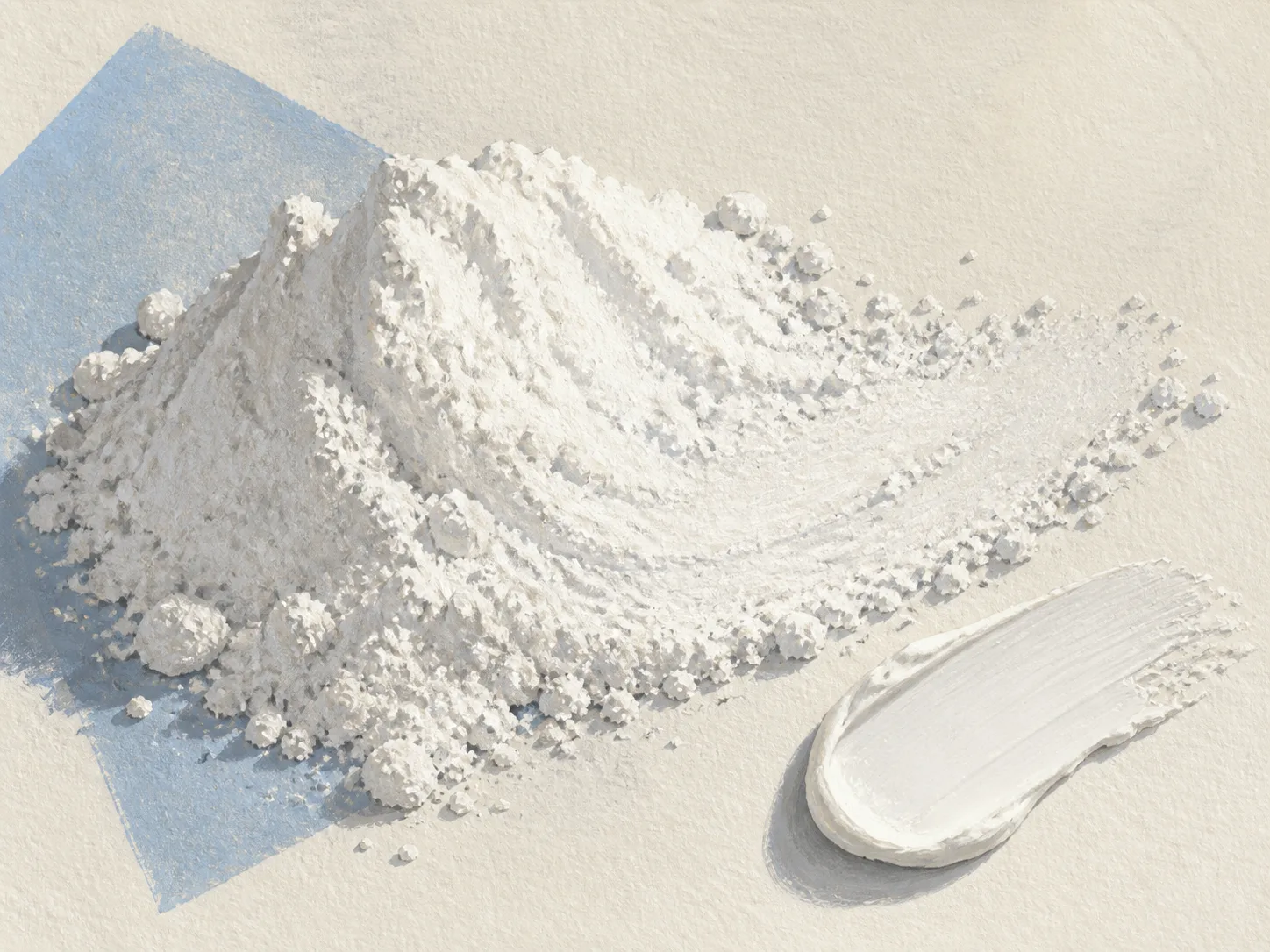
Titanium Dioxide, or TiO2, is a white inorganic particle that may also appear as CI 77891. It can be a UV filter in sunscreen or a pigment that controls color and opacity in another cosmetic. Its presence alone does not tell you the product’s purpose or concentration.
The familiar explanation that mineral filters simply bounce UV away is incomplete. Titanium Dioxide absorbs much of the UV that reaches it and scatters or reflects a smaller portion. Absorption occurs when a photon raises an electron to a higher energy state; that energy is later dissipated in other forms. Differences in refractive index at and around the particles also redirect light.
The sunscreen benefits of Titanium Dioxide in skincare
Titanium Dioxide performs well across UVB and UVA-II, the shorter part of UVA. UVB is closely associated with sunburn. UVA reaches deeper and contributes to pigmentation and photoaging. Protection from longer UVA-I wavelengths can be less complete with Titanium Dioxide alone.
An ingredient list cannot establish SPF or UVA performance. Concentration, dispersion, film uniformity, and the rest of the filter system all contribute to the finished-product test. Look for a broad-spectrum claim and the UVA rating used in your market rather than treating one mineral name as proof.
In the US OTC sunscreen context, the FDA has described sufficient safety and efficacy data for Titanium Dioxide and Zinc Oxide at concentrations up to 25% under the proposed conditions. This is a regulatory ceiling, not a universal target for every cosmetic. Follow the label and testing framework of the product sold in your region.
Particle size changes white cast, but it is not the only variable
Particles near visible-light wavelengths scatter that light strongly, which makes the film look white or gray on skin. Reducing particle size can lower visible scattering and improve transparency. It does not single-handedly determine protection or elegance.
Rutile versus anatase crystal form, surface coating, agglomeration, oils, and dispersants also matter. Clumped particles leave uneven white patches and gaps in the film. Coatings can improve dispersion and reduce unwanted photoreactivity. In tinted sunscreens, iron-oxide pigments can compensate for white cast and add protection against some visible light.

The word nano is not a complete risk assessment. Size distribution, surface treatment, purity, crystal form, and exposure route must be considered together. A shopper cannot reliably reconstruct those properties from the ingredient order, which is why finished products and regional safety rules matter.
Skin exposure and inhalation are separate questions
The European SCCS opinion on nano Titanium Dioxide addresses specified materials and conditions on healthy, intact skin. Applied particles are generally evaluated as remaining mainly at the stratum-corneum surface and follicular openings. That conclusion cannot be copied into a scenario where airborne particles reach the lungs.
Loose sunscreen powders and aerosol sprays can create inhalable particles. Avoid spraying them near the face or mixing raw Titanium Dioxide powder into homemade sunscreen. Creams, lotions, and sticks bind particles in a vehicle and create a different exposure route.
Follow specific product directions around broken skin, the eyes, and use on young children. If a sunscreen stings or causes a rash, the culprit may be another filter, fragrance, preservative, or the whole base formula rather than Titanium Dioxide alone.
Application determines whether the filter can do its job
A sunscreen must form a continuous film. Too little product or missed areas around the nose, ears, and hairline leave breaks regardless of filter type. Apply an even layer before exposure and reapply according to the label, especially after swimming, sweating, or toweling.
If white cast makes you apply too little sunscreen, try a tinted product, a blend of mineral and organic filters, or a lotion that spreads more evenly. Choose a texture you can comfortably apply in the recommended amount.
Some sensitive skin users prefer mineral-filter formulas, but mineral does not mean universally non-irritating. A drying base, fragrance, alcohol, or harsh cleansing can matter more to comfort. Reliable sun protection comes from a tested product you can apply generously and repeatedly, not from a reassuring ingredient category.
Sources used
- Korea Cosmetic Association ingredient reference
- PubChem: Titanium dioxideIngredient identity, molecular formula, and structure reference.
- FDA Q&A on OTC sunscreen active ingredients
- SCCS revision of the opinion on titanium dioxide nano form
- American Academy of Dermatology: decode a sunscreen label
- DermNet: topical sunscreen agents
- Cancer Council Australia: the science behind sunscreen and SPF
- Source from ktr.or.kr