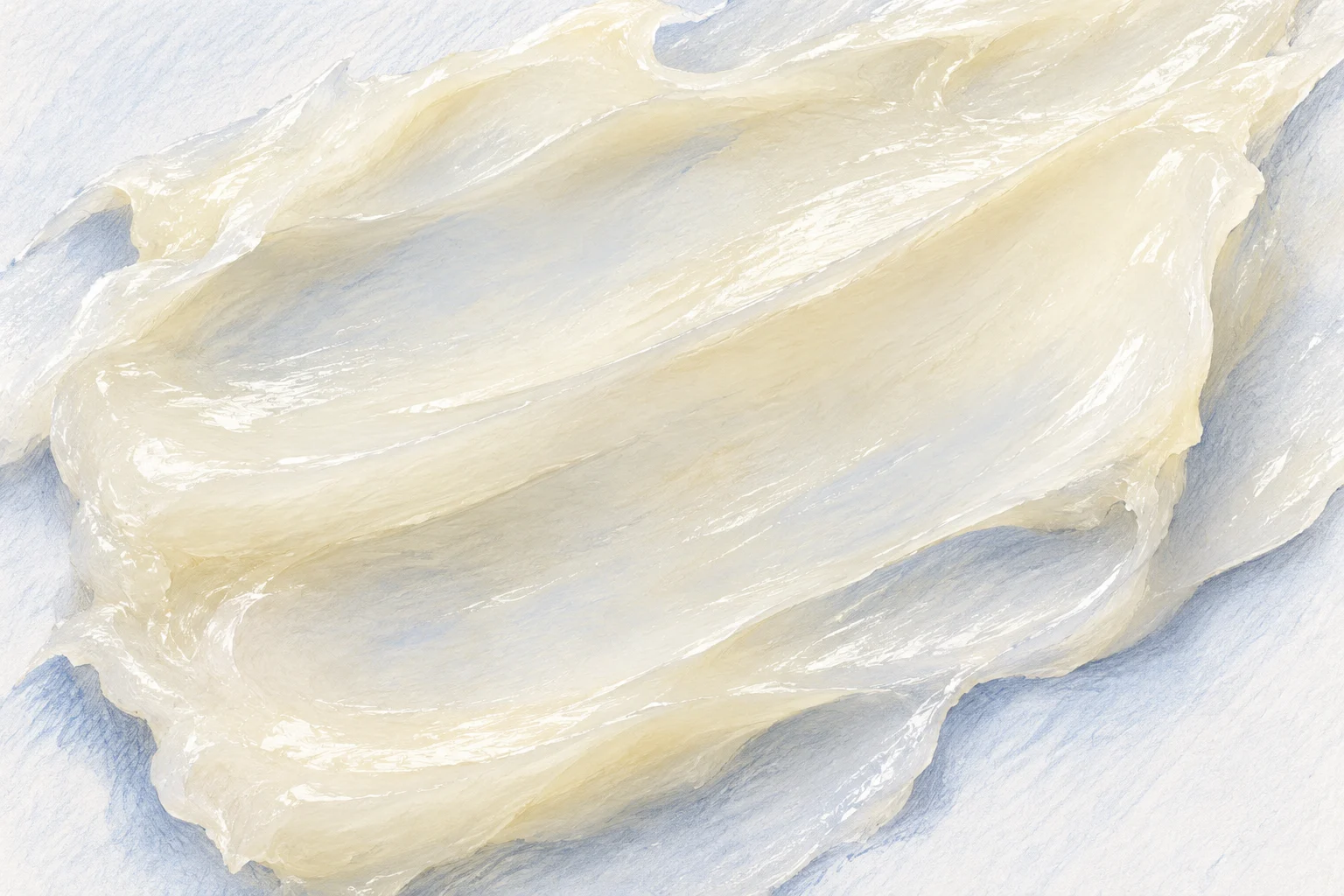
Petrolatum, familiar as petroleum jelly, forms an oily film that slows water loss from skin. It helps keep dry lips and rough patches soft by retaining moisture. That makes it useful when parts of your face feel dry again soon after moisturizing.
You can use it on your face. If your skin is oily or acne-prone, however, avoid covering the whole face with it. A small amount on a persistently dry area may be all you need.
What is petrolatum?
The Korean Cosmetic Association dictionary describes petrolatum as a semisolid mixture of hydrocarbons obtained from petroleum and lists moisture-loss prevention among its cosmetic functions. Its ointment-like consistency is part of what makes it useful in richer skin-care products.
Vaseline is a brand name; petrolatum is the ingredient used in its petroleum jelly. This jelly product lists petrolatum, while creams may combine it with water and other ingredients. Products from the same brand can have different formulas. Here, the focus is on petrolatum itself, using cosmetic-grade material that meets refining and quality requirements.
How does the film help dry skin?
Water gradually escapes through the skin surface. Petrolatum leaves a water-resistant layer that reduces this loss. This differs from the water-binding action of a humectant such as glycerin, as explained in DermNet’s guide to barrier creams.
A study of 51 healthy volunteers with dry skin compared a combined glycerol–petrolatum cream with formulas containing either ingredient and with the base cream. Measurements on the forearms over 12 hours supported complementary effects: glycerol contributed to hydration and petrolatum to reduced water loss.
The manufacturer-supported study measured moisture after a single application to the forearms. It did not test acne treatment or wrinkle reduction on the face.
Does slugging require a thick layer all over your face?
Slugging means adding an occlusive layer, often petroleum jelly, after moisturizing. You can use the same principle more selectively. If your cheeks remain dry but your forehead is oily, there is no need to treat both areas identically.
The American Academy of Dermatology recommends applying petroleum jelly to damp skin when using it for dryness. After washing, pat skin gently, apply your usual moisturizer and add a small amount where needed. A thick, visibly glossy coating is not the goal.
| What you notice | An approach to consider |
|---|---|
| A dry patch returns after moisturizing | Add a thin layer only over that area |
| Lips feel dry and rough | Use a small amount of a product suitable for lips |
| Your face is oily and breaks out easily | Avoid full-face slugging and reconsider your usual moisturizer first |
Be careful about what goes underneath
Cleveland Clinic’s dermatologist guidance warns that covering retinoids or exfoliating acids such as AHAs and BHAs can increase irritation. Do not add petroleum jelly to make your retinol work harder. If you try slugging, keep the routine underneath simple rather than combining several active products.
The American Academy of Dermatology also cautions that facial petroleum jelly can trigger breakouts in some acne-prone people. A non-comedogenic product description is not a guarantee that full-face occlusion will suit you. Do not cover skin that appears infected or is weeping as a do-it-yourself moisturizing treatment.
Adjust the amount and area to how your skin feels. Dry lips or a patch of cheek may benefit from a thin layer; on days when your usual cream keeps everything comfortable, you can skip it.
Sources used
- Korean Cosmetic Association ingredient dictionary: PetrolatumPetrolatum identity, semisolid hydrocarbons and moisture-loss prevention
- Combined effects of glycerol and petrolatum in an emollient creamManufacturer-supported, 51-person forearm study over 12 hours comparing cream formulas
- American Academy of Dermatology: 5 ways to use petroleum jelly for skin careUse for dry skin and lips, damp-skin application and acne-prone skin precautions
- Cleveland Clinic: SluggingSelective slugging, retinoid and acid irritation, acne and infection precautions
- Vaseline Jelly OriginalPetrolatum identity in a finished petroleum-jelly product
- DermNet: Barrier creamWater binding by glycerin and hyaluronic acid versus petrolatum occlusion