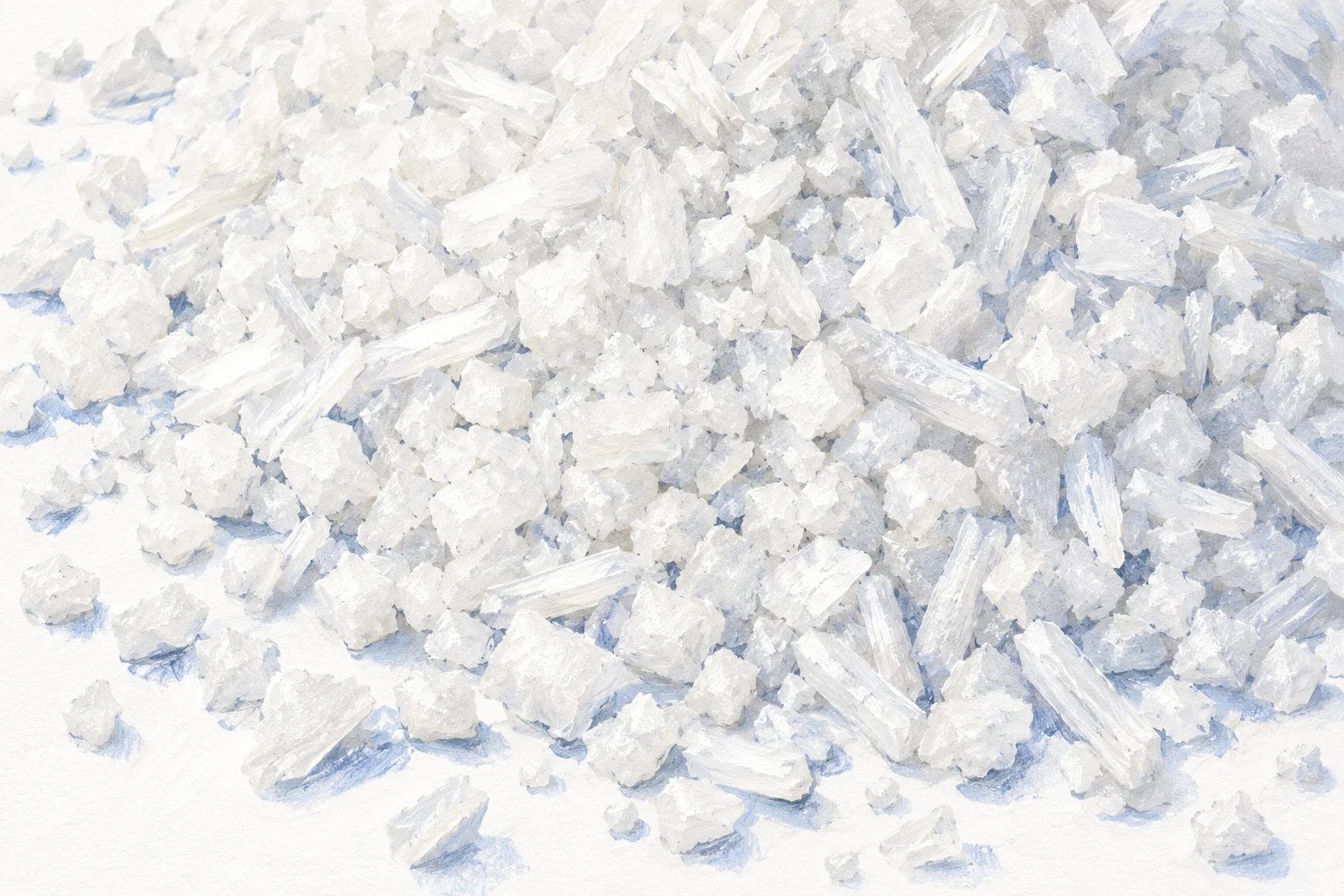
Urea moisturizes dry skin and softens rough, thickened patches
Urea has two uses that explain why it appears in both body lotions and foot creams: it helps skin hold water, and at higher concentrations it softens hard, built-up skin. Dry shins and thick heel calluses do not necessarily need the same product.
A larger percentage is not automatically a better choice. A lotion for everyday body dryness has a different job from a cream intended for a small patch of thick skin. Check where the product is meant to be used before comparing percentages.
What is urea, and where does it come from?
Urea is also called carbamide. It occurs naturally in the skin’s outer layer as part of its natural moisturizing factor—the mixture of substances that helps that layer retain water. Cosmetic urea is manufactured synthetically; its association with urine does not mean a moisturizer is made from urine. COSMILE Europe lists it as a synthetic cosmetic ingredient used in creams and lotions.
On a Korean ingredient label, 우레아 is the standardized name. You may also encounter 요소 in explanations of the same substance.
How does it moisturize and soften skin?
Urea attracts and retains water in the outer skin layer. Better hydration makes dry skin more flexible and helps reduce its rough feel. That moisturizing action does not require scrubbing away the surface.
At higher concentrations, urea also affects keratin, the protein that gives the outer skin layer its structure. A dermatology review describes changes to keratin’s hydrogen bonds and protein structure that help soften thickened skin. This is why urea can be useful for a hard patch as well as for dryness.
What do 5%, 10% and 20% mean on the label?
| Concentration | What to look for | Check before use |
|---|---|---|
| Around 5% | A moisturizer for everyday dryness | Facial use should be specified on the product |
| Around 10% | Moisturizing care that also addresses rough texture | Whether it is a body lotion or a foot product |
| Around 20% | Targeted care for thicker, harder skin | Do not extend it to the face or entire body without appropriate directions |
These are shopping distinctions, not sharp biological cutoffs. Published moisturizing and keratolytic concentration ranges overlap. The formula and application site also matter. High-strength preparations such as 30–40% have specialized uses, including medical nail care; they should not be treated as ordinary facial moisturizers.
What has a 10% cream study shown?
In a two-week study of 20 adults aged 65–82, participants applied a 10% urea cream twice daily to dry arms and legs. Assessments of dryness, itch and visible scaling improved.
There was no comparison group. The findings concern that complete cream in those participants, rather than the isolated effect of urea or proof that everyone will obtain the same result. The useful point is that investigators assessed dryness and scaling, not just how moisturizing the cream felt on application.
Why can two products with the same percentage feel different?
The rest of the formula matters. A commercial 10% body lotion, for example, combines urea with ceramide and other natural moisturizing factors. Its claims about lasting moisturization describe the finished formula, not what 10% urea would achieve on its own.
Choose for the job first: widespread dryness, a rough patch, or thickened heel skin. Then check the intended application area, texture and directions. A product designed for feet is not a substitute for a facial moisturizer simply because both contain urea.
Apply after washing, but avoid damaged skin
Cleveland Clinic’s guidance notes that applying to skin that is still slightly damp after bathing may improve moisturization. Follow the product directions and try a small area when starting.
DermNet advises against use on cracked or bleeding skin, infected or oozing areas, or severely reddened skin. A rough heel and an open heel fissure need different care. Stop using the product if stinging or a rash persists, and keep strong foot preparations away from the eyes and lips.
Is hydroxyethyl urea the same ingredient?
No. Hydroxyethyl urea is a separate ingredient. A hydrating serum containing it should not be assumed to have the thick-skin-softening purpose of a concentrated urea foot cream.
For daily dryness, start by finding a moisturizer suitable for the area you want to treat. For thickened skin, look for a product specifically intended to soften it. The most useful percentage is the one that fits the product’s purpose and your application site—not the highest number on the shelf.
Sources used
- 대한화장품협회 성분사전: 우레아Standardized Korean name and INCI identity
- COSMILE Europe: UreaSynthetic origin, natural moisturizing factor and cosmetic uses
- DermNet: UreaHydration, softening thickened skin and damaged-skin precautions
- Cleveland Clinic: Urea creamApplication after bathing and care around sensitive areas
- Urea in Dermatology: A ReviewConcentration ranges and effects on keratin
- 10% urea cream in senile xerosis: Clinical and instrumental evaluationTwo-week complete-cream study in 20 adults aged 65–82
- Eucerin UreaRepair PLUS: 10% Urea Body LotionExample of a body lotion combining urea, ceramide and other moisturizing factors