The benefit you are most likely to notice
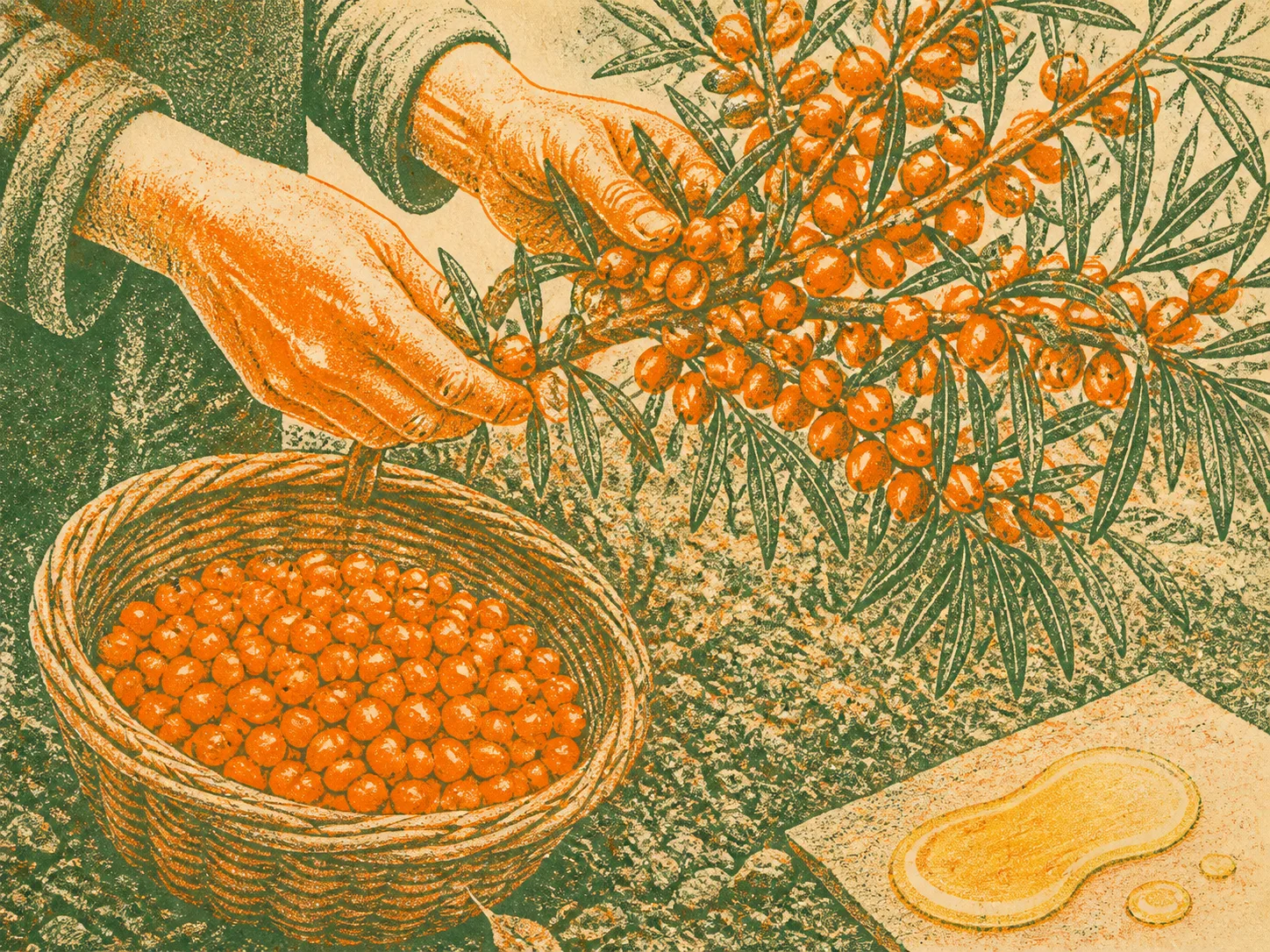
Sea Buckthorn Fruit Oil is most useful for softening rough, dry skin and easing the tight feeling that follows rapid water loss. This orange oil comes from the fruit pulp of Hippophae rhamnoides. Its lipids, including palmitoleic and palmitic acids, settle between flaky surface cells and leave a fine emollient film.
The film slows the escape of water already present, so the surface feels smoother, more flexible, and less papery. Carotenoids and tocopherols in the oil also make it useful in formulas designed to support skin exposed to oxidative stress.
Fruit oil is not seed oil
Sea buckthorn fruit contains pulp around a separate seed. Oil pressed from those two parts does not have the same composition. Fruit-pulp oil is notable for palmitoleic and palmitic acids and often has a strong orange color. Seed oil tends to contain more linoleic and alpha-linolenic acids.
This distinction matters when reading studies. Research on Sea Buckthorn Seed Oil and markers such as AQP3 or HAS2 cannot be presented as direct proof for Hippophae Rhamnoides Fruit Oil. The plant is the same, but the INCI, fatty-acid balance, and test material are not.
How the lipid film changes dry skin
The stratum corneum is often compared with bricks and mortar. Corneocytes are the bricks; ceramides, cholesterol, and fatty acids form much of the mortar. When that surface arrangement is depleted or disrupted, water escapes faster and the edges of dry cells lift, producing a rough feel.
Fruit-oil lipids act as emollients that smooth those raised edges and fill some surface gaps. The remaining film slows evaporation. This complements a humectant such as glycerin, which attracts and holds water. A cream containing both can supply water-binding ingredients and a lipid layer that helps retain the result.
An ex vivo study applied sea-buckthorn pulp oil to isolated human skin and tracked its fatty acids over six hours. It helps explain contact and movement through skin layers, but it was not a clinical trial measuring wrinkles, wounds, or visible recovery in people. In skincare, the oil is mainly used to soften dry skin and reduce tightness.

What the orange color tells you—and what it does not
The vivid color is associated with carotenoids. Tocopherols and other oil-soluble compounds can also participate in antioxidant reactions. Laboratory and animal studies of fruit-pulp oil have reported changes in oxidative and inflammatory measurements, which provides a reason to study it in stressed-skin formulas.
Color is not a potency meter. Growing region, maturity, extraction, refining, storage, and dilution all change appearance and composition. A pale serum may contain a small amount of fruit oil, while a dark orange balm is not automatically more effective. Choose a stable formula that feels comfortable on your skin.
Who may enjoy it
Dry, rough, or weather-stressed skin is the clearest match. Creams, balms, and facial oils make the emollient effect easy to feel. In lighter serums or sunscreen bases, a small amount can improve slip and reduce a brittle finish when balanced with emulsifiers and other oils.
Oily skin does not have to avoid the ingredient, but a heavy oil-rich product may feel glossy or occlusive. Judge the finished texture. Applying a thin layer only to dry areas can work better than covering the entire face.
Practical cautions
Deeply colored products may mark pale fabric, so begin with a small amount. Oils also change as they oxidize. Store the product away from heat and direct light, respect its use-after-opening period, and stop if the odor changes sharply. Patch test a new leave-on product if your skin reacts easily.
Sources used
- Korea Cosmetic Association ingredient reference
- CIR ingredient record: Hippophae Rhamnoides Fruit Oil
- COSMILE Europe: Hippophae Rhamnoides Fruit/Seed Oil
- Sea buckthorn oil review: chemistry and skin-related applications
- Ex vivo human skin penetration of sea-buckthorn pulp oil fatty acids
- Sea buckthorn fruit pulp oil composition and topical activity
- Source from coos.kr
- Seaberry Fruit Oil cosmetic technical specification